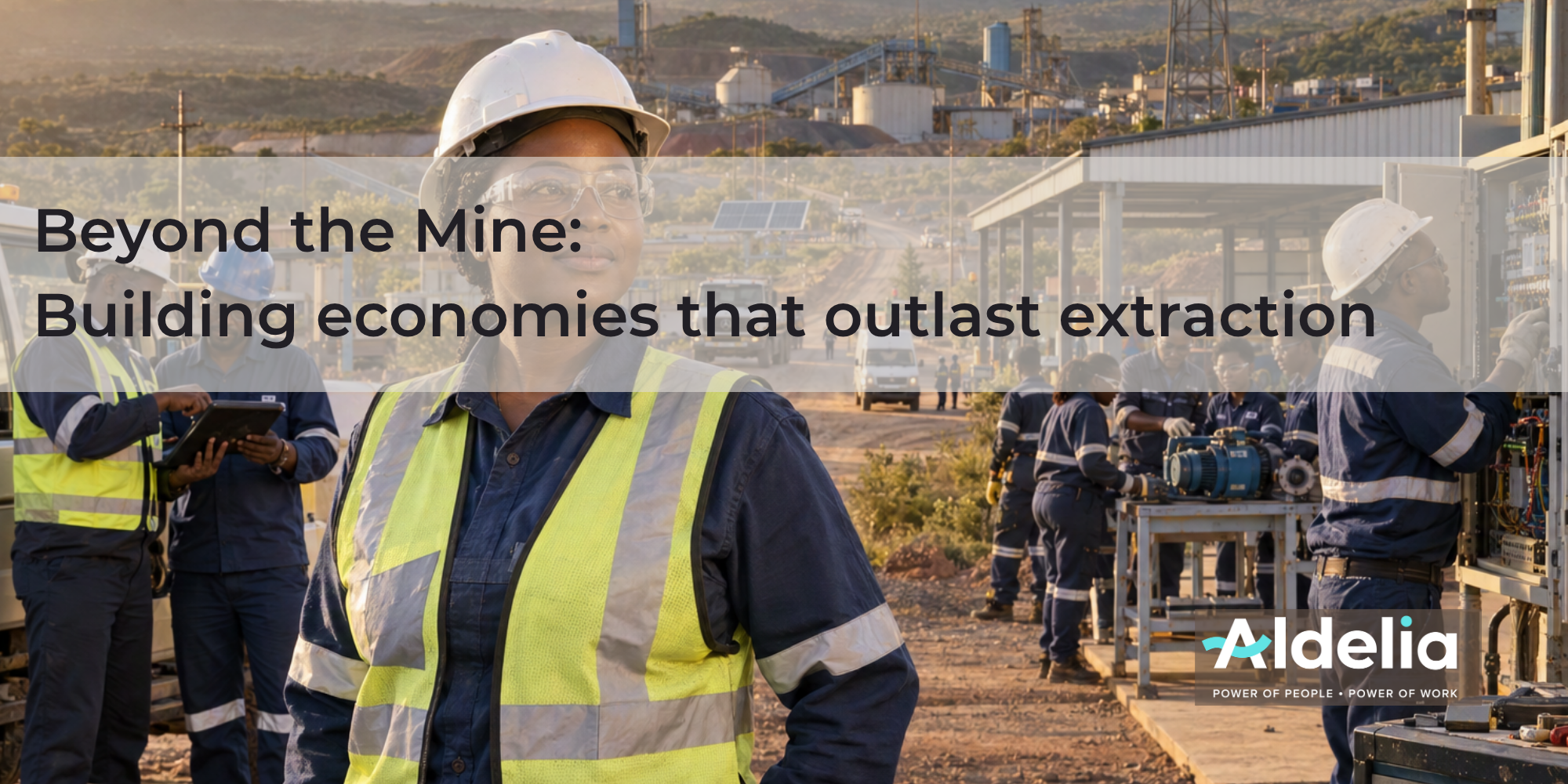
Beyond the Mine: Building Economies that Outlast Extraction
Industry Focus: Mining
Beyond the Mine: Building Economies that Outlast Extraction
Mining is measured in tonnes extracted, capital invested and reserves remaining. Some of its most important outcomes are harder to count: a young technician's new qualification, a local contractor that grows into a regional supplier, expertise that stays in a community long after construction ends.
Governments now expect exactly that. On 16 October 2026, the World Bank Group said it plans to lift its metals and minerals support fivefold, from US$3.6 billion in FY2021–25 to US$19 billion in FY2026–30. On the same day, eight countries, including four in Africa, launched country partnerships and compacts designed to strengthen skills, infrastructure, local supply chains and domestic economic value.
For mining companies, the question is no longer how many people a mine employs. It is how much lasting economic capacity its workforce, procurement and knowledge requirements create.
A mine's footprint is larger than its payroll
Behind every engineer, operator or geologist sits a wider ecosystem: construction firms, equipment specialists, maintenance providers, transport, security, catering, accommodation, healthcare and training organisations. Each employs people and buys from others.
The scale is visible in industry data. International Council on Mining and Metals (ICMM) members paid US$217.4 billion to suppliers in 2024, almost five times the US$45.5 billion paid in wages and related payments.
Both figures come with a caveat. They describe global spend, not local spend. A 2020 South African Institute of International Affairs (SAIIA) review found that mine sites often report as much as 90% of procurement as national, yet much of that is imported goods resold by local agents. Mining can also behave as an enclave economy, with value leaking through imports, fly-in/fly-out staffing and remittances.
The real measure of a mine's contribution, then, is not how much it spends but how much stays.
Local hiring is not local capability
Employment is the first thing communities expect and one of the hardest to deliver. The skills a mine needs most (mining engineers, metallurgists, heavy-equipment technicians, HSE professionals, experienced supervisors) are often scarce locally, at least at the scale and speed a project requires.
The answer is not to choose between local and international talent. It is a workforce model that maps what exists locally, identifies the gaps and builds a credible pathway to close them: vocational training, apprenticeships, graduate programmes, certification, mentoring and structured handover.
That pathway should look ahead. Automation, remote operations, predictive maintenance and data-driven processing are changing the skills a mine needs, so a plan built around today's vacancies may be outdated before a long-life asset reaches maturity.
Done well, international mobility and localisation reinforce each other. Specialist expatriates solve immediate technical needs while transferring knowledge to national colleagues who progressively take over supervision and leadership. A technician who enters with basic skills and leaves as a qualified specialist is a different economic contribution from a short-term job.
Skills are economic infrastructure. Without qualified people, roads, power and processing plants cannot deliver their full potential.
Procurement: build suppliers, not just spend
Local procurement follows the same logic. The World Bank has long treated it as a route to wider benefits, including in its practical guide for West Africa. Transport, catering, facilities management, maintenance, accommodation and professional services all offer openings where capability exists or can be developed.
The companies that do this well tend to report it. Barrick's Lumwana mine in Zambia spent US$432 million of US$520 million with Zambian-registered businesses in 2022 (83%), and reports that 99.3% of its employees are Zambian nationals. Its Business Accelerator Program, launched in 2022, is intended to help Zambian contractors diversify their markets and stay sustainable beyond Lumwana's life of mine.
Localisation does not mean lowering standards. Safety, compliance and reliability remain non-negotiable, which is why supplier development matters: helping local firms reach those standards so they can win more demanding contracts. A transport company that builds strong safety systems for one mine can later bid for construction or energy work. A maintenance contractor can serve several mines.
The aim is not to redirect spend. It is to use mining demand to build businesses that can compete beyond the original project.
The boom, the bust and what remains
It is fair to ask why a company would invest in people and suppliers that may later serve others. The answers are practical: local-content rules are tightening, social licence to operate depends on visible local benefit, a deeper national talent pool lowers long-term reliance on costly expatriate premiums, and resilient communities are better partners over a 20-year asset life.
The funding question is real too. Training capacity works best when companies, governments and education providers share it, and the new World Bank compacts are designed to support that kind of coordination.
A salary's impact does not stop with the employee. Household spending supports housing, schools, retail and services. World Bank research covering 109 mine openings and 84 closures in Sub-Saharan Africa, and roughly 800,000 individuals, shows mines shifting local employment, within about 20 km of the site, from agriculture towards skilled work and services. It also warns of boom-and-bust cycles, which makes diversification as important as job creation.
Every mine has a lifecycle, and commodity cycles can reshape employment long before closure. The test of a mining legacy is what remains: tradespeople who can work in other industries, entrepreneurs serving new markets, suppliers that meet international standards. That means training for employability, with recognised qualifications and broad technical competence rather than a single task, and developing suppliers who can serve other mines and industries rather than depending on one customer.
People are infrastructure too
If workforce strategy begins when a project needs to hire, the window for building local pipelines has often already narrowed. Planning should run alongside feasibility, permitting and construction design: what skills each phase needs, what exists locally and where the gaps will open, years before those skills become critical.
For Aldelia, this is where workforce strategy earns its place. Supporting a mining operation means knowing where talent will come from, how specialist expertise can be mobilised compliantly and how complex workforces are managed across jurisdictions and project phases.
Beyond extraction
Extraction alone will not decide whether the world's demand for minerals becomes lasting prosperity. Local employment should not be treated as a target to hit, nor local procurement as a compliance exercise. Both belong in a deliberate strategy for building capability.
Mining projects have finite lives. Skills, businesses and knowledge do not have to.
Planning a new mining project or expansion? Talk to Aldelia's mining workforce team about building readiness into the project from day one.